No implicit rule allows you to create a private parking space on your own land, even if the land registry grants you full ownership. The Local Urban Plan strictly regulates any transformation, and the Urban Planning Code requires a prior declaration, sometimes even a building permit depending on the scope of the modifications. In co-ownership, the internal regulations may oppose any marking or installation, even if the lot appears in the notarial deed.
A parking space installed without authorization can lead to administrative or civil penalties. Even direct access to the public road cannot be improvised: explicit agreement from the town hall must be obtained, regardless of the land’s cadastral situation.
Understanding the essential rules for creating a private parking space
To create a private parking space, the first step is to consult the local urban plan (PLU) which defines the authorized uses for each plot. This document sets out the precise conditions for any creation of a parking area, whether it borders a house or is isolated. In Paris, Marseille, Nantes, or Toulouse, each municipality establishes its own rules: minimum surface area, access conditions from the roadway, preservation of green spaces, management of rainwater.
The regulation of dimensions is based on the NF P 91-100 standard: plan for at least 2.5 meters wide by 5 meters long for a standard vehicle. For spaces accessible to people with reduced mobility, these figures increase. Requirements vary depending on whether you are setting up an individual or collective parking space, in a subdivision or within a co-ownership.
There are two possible procedures depending on the scale of the project: a prior declaration of work or a building permit as soon as the area exceeds 20 m². In a protected area, the opinion of the architect of the buildings of France becomes essential. Finally, any opening of a drivable access to the public road requires a dedicated request to the town hall.
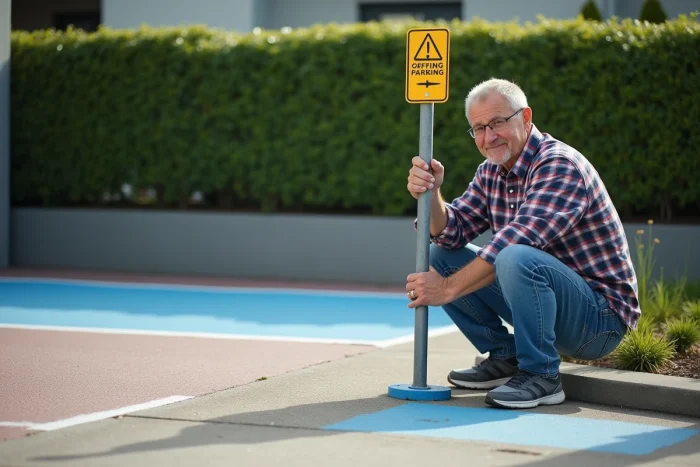
To go further on the steps to follow to create a private parking space, consult the detailed article: Developing a parking space on private land: rules to know and key steps. Remember to clearly mark your space with visible ground markings and ensure that you do not obstruct access for neighbors or common facilities.
What rights and obligations do owners and users have?
Owners: responsibilities and regulatory framework
The owner of a private parking space in a co-ownership must comply with the co-ownership regulations. This text details the use reserved for each lot, access modalities, possible restrictions on the type of vehicles allowed or on development work. Installing a charging station or closing a space requires prior agreement from the property manager and often a vote at the general assembly. Renting the space involves drafting a contract in accordance with the civil code.
Here are the points to respect to avoid any disputes:
- Comply with the co-ownership regulations and the common areas
- Inform the property manager before any project of work or development
- Rent the space, subject to compliance with collective rules
Users: uses and duties
The occupant or tenant of a parking space must limit themselves to the intended use: parking a vehicle (car, two-wheeler), without modifying the space or turning it into a storage area. In case of nuisances, non-compliance with the rules, or abusive occupation, the property manager can intervene, sometimes by sending a formal notice.
Life in co-ownership also requires adherence to the traffic code in common areas, maneuvering carefully, and never obstructing access to other spaces. Violations are subject to penalties provided for in the internal regulations.
| Right | Obligation |
|---|---|
| Have a reserved space | Respect the designated use of the space |
| Possibility of rental | Notify the property manager in case of modification |

Practical advice and steps to follow for a compliant and secure project
Anticipate the immediate environment and urban constraints
Before starting the creation of a private parking space, closely observe the immediate environment. Measure the available area, assess traffic, check access from the street, the proximity of other parking spaces, and passageways. Some cities like Paris, Marseille, Nantes, or Toulouse add requirements, all recorded in their local urban plan (PLU). Compatibility with the land’s intended use must take precedence.
To get off to a good start, keep these key steps in mind:
- Consult the PLU to know the regulations for your neighborhood.
- Submit a file to the town hall, including a layout plan, dimensions, planned access, and landscaping integration.
- Opt for clear ground markings to signal the reserved space.
Administrative procedures and project security
Any private parking space adjacent to a house or located in a co-ownership requires a prior declaration. If the area exceeds 20 m² or if the development modifies the facade, a building permit is required. Technical standards (NF) regulate width, traffic, and fire safety.
Consider securing access: appropriate signage, sufficient lighting, barriers, or access control if necessary. Careful ground marking limits conflicts and promotes adherence to the rules. Prepare your budget by including administrative fees, potential taxes, and development costs.
Ultimately, a well-designed, compliant space integrates smoothly into the urban fabric. It facilitates daily life, avoids disputes, and enhances property value. A well-executed project guarantees serene parking, where every square meter counts.