
Tansy colonizes slopes, road edges, and wastelands without anyone taking care of it. In the garden, this vigor becomes an asset provided you choose the right method of propagation according to your soil and your schedule. Multiplying tansy is not just about sowing seeds: the result depends on the type of soil, the timing, and how you manage its expansion.
Dividing clumps of tansy in clay soil: the method that changes everything
Are you gardening in heavy, sticky soil in spring? Sowing tansy in this type of soil often yields disappointing results. The very fine seeds struggle to germinate in a compact substrate that retains too much water on the surface.
Dividing clumps remains the most reliable method in clay soil. According to field reports compiled by FNAMS (National Federation of Seed Multiplying Farmers) in its 2025 practical guide, the success rate reaches about 90% with this technique, where direct sowing frequently fails in clay.
Specifically, take a chunk of the root with a well-sharpened spade. Each portion should retain several stems and a dense root network. Replant immediately in a hole slightly wider than the root ball, pressing firmly to eliminate air pockets. Water once, thoroughly. Tansy will take root in a few days.
To delve deeper into the techniques for multiplying tansy, division remains the recommended starting point before exploring sowing or cuttings.
Sowing and cutting tansy: when to favor each technique
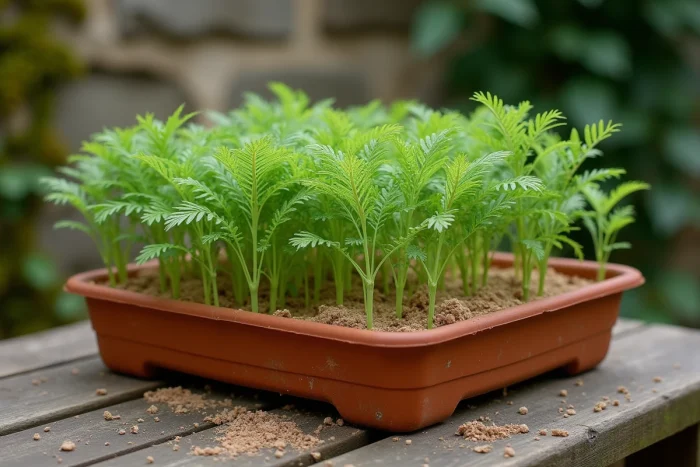
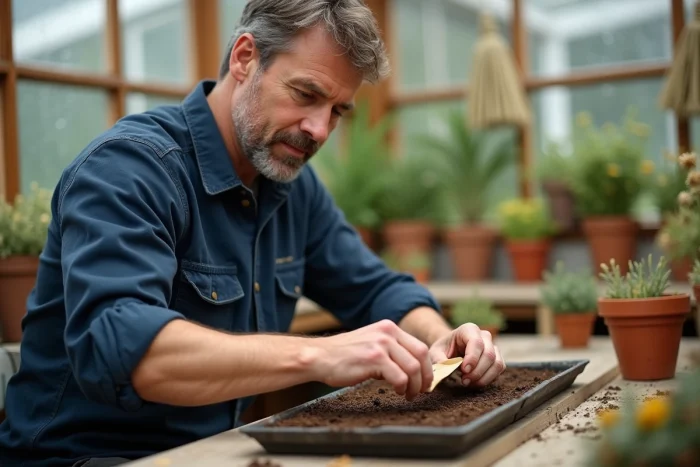
Sowing remains relevant in light, sandy, or loamy soils. Sow on the surface in fine potting soil, without covering the seeds: they need light to germinate. Keep the substrate moist without waterlogging it. Germination usually takes two to three weeks.
The right schedule for sowing
Indoors, start as early as the end of winter to transplant after the last frosts. In open ground, wait for the soil to warm up, typically in April in the southern half, and May in the north.
Selected strains show increased resistance to late frosts in recent years. The Network of Shared Ecological Gardens reports in its 2025-2026 trial report that certain strains allow for early multiplication as early as the end of March in northern France, without significant loss.
Stem cuttings in summer
Take a herbaceous stem about the length of pruning shears, just below a node. Remove the lower leaves, plant in a sand-potting soil mix, and keep in the shade. Rooting takes a few weeks. This method produces plants identical to the mother plant, allowing you to maintain a cultivar with crisp foliage or a compact form.
- Heavy clay soil: favor clump division in spring or autumn
- Light, draining soil: surface sowing works well, in pots or in open ground
- Identical reproduction of a specific cultivar: choose stem cuttings in summer
Tansy in a permaculture spiral: controlled propagation without invasion
Tansy spreads through its underground rhizomes. Without a barrier, it gains ground each season. Have you noticed stems appearing more than a meter from the original plant? This is a sign that the rhizomes are working deep down.
Incorporated into a permaculture spiral, tansy finds an environment that naturally limits its expansion. The spiral, built with stones or logs, creates compartments at different heights. Place the tansy in the lower zone, outside the spiral, where the soil remains cooler.
Why the spiral works as a barrier
The walls of the spiral act as a physical barrier for the rhizomes. Tansy colonizes its compartment without invading the areas planted with more delicate herbs (thyme, oregano, sage) located at the top of the spiral, in a drier and more draining substrate.
Bury a rigid border 30 cm deep around the compartment reserved for tansy. The rhizomes rarely go deeper. This simple precaution prevents any migration to neighboring crops.
The collateral advantage is real: tansy placed at the bottom of the spiral repels several garden pests (aphids, ants, cabbage whites) with its camphor-like scent while attracting beneficial insects to its yellow flowers in summer.
Tansy as an anti-erosion ground cover in organic gardening
Beyond multiplication for the vegetable garden, tansy is gaining ground in organic farming for an unexpected use. ITAB (Technical Institute of Organic Agriculture) reports in its 2025 annual bulletin a growing trend in the use of tansy as an anti-erosion ground cover, particularly on moderate slopes.
Farmers in polyculture observe a significant reduction in runoff thanks to the plant’s dense root network. In the garden, this translates into a concrete interest: multiply tansy by division along a slope or a sloped border to stabilize the soil while creating a low repellent hedge.
The principle is simple. Space the root chunks 40 to 50 cm apart. In two seasons, the rhizomes fill the gaps and form a continuous mat. The finely cut, dense, and persistent foliage for much of the year limits the impact of rain on bare soil.
- Plant on a slope exposed to rain to slow down runoff
- Combine with low grasses to strengthen root anchorage
- Harvest flowering stems in summer to prepare repellent infusions, without weakening the ground cover
Multiplying tansy in the garden requires neither expensive equipment nor complex know-how. The choice of method primarily depends on your soil: division in clay, sowing in light soil, cuttings to reproduce a cultivar. By channeling its rhizomes with a buried border or a spiral, you can enjoy its vigor without being overwhelmed.