What concrete criteria distinguish a handmade baby accessory from an industrially produced one when both product listings promise “softness” and “comfort”? The answer has nothing to do with aesthetics or brand storytelling, but with what you can verify before buying: textile composition, regulatory compliance, and transparency in the online listing.
Safety of handmade baby accessories: what regulations have required since 2024
Since December 13, 2024, Regulation (EU) 2023/988 has governed the general safety of products sold online, including handmade creations. For parents, this means every online store must display certain information in its listings: product identification, the manufacturer’s contact details, and any applicable safety warnings.
One point deserves particular attention: handmade or second-hand items are not exempt from these requirements. The European regulation also covers certain refurbished or repaired products when they are placed back on the market as part of a commercial activity. Handmade production alone does not guarantee compliance.
Among the baby accessories at Un P’tit Air de Famille, this commitment to transparency is reflected in French-made creations, with product listings detailing materials and manufacturing conditions.
Handmade vs. industrial: criteria you can check before buying
Labels such as “handmade,” “organic cotton,” or “made in France” can guide your choice, but they do not offer the same guarantees. The table below highlights criteria you can actually verify in a product listing, whether you’re looking at a bib, a muslin cloth, or a sleep sack.
| Criterion | Handmade accessory (online store) | Industrial accessory (large retailer) |
|---|---|---|
| Manufacturer identification | Often provided (named artisan, workshop location) | Company name, sometimes an importer |
| Detailed textile composition | Varies: some specify fabric weight and cotton origin, others do not | Standard regulatory labeling (fiber percentages) |
| Safety warnings | Provided if the seller complies with Regulation 2023/988; absent from some small stores | Generally compliant with legal requirements |
| Cords and fastenings | Design is unrestricted and may not refer to EN 14682 | Design is governed by retailer specifications |
| Voluntary textile certification (Oeko-Tex, GOTS) | Available from some workshops, but not standard | Common in “organic” ranges |
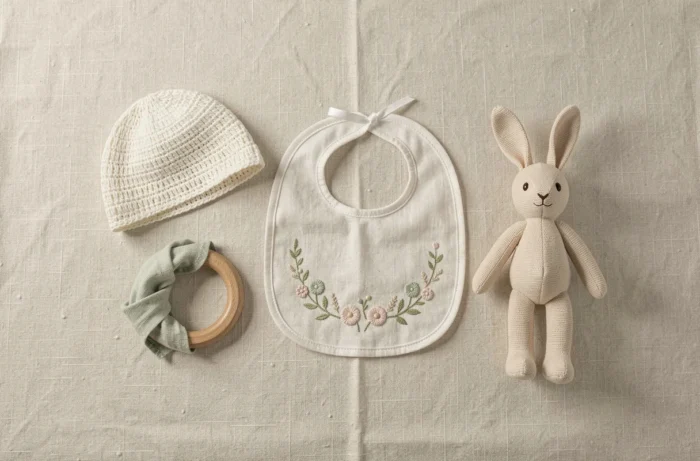
The clearest differences concern safety warnings and how cords are handled. An artisan who designs a bandana bib with a tie around the neck may not necessarily refer to EN 14682. Since April 27, 2026, this standard has been listed in a European decision as a reference for presuming compliance with general safety requirements, but only for risks associated with cords on children’s clothing.
Textile certifications and handmade baby products: what a certificate actually covers
A voluntary textile certification such as Oeko-Tex or GOTS confirms that certain substances are absent from the fabric. It provides reassurance about the material’s composition. However, a textile certification does not replace a safety assessment of the finished product.
Compliance with a standard on cords, for example, is not enough to rule out every risk. The assessment must also take into account the overall design, labeling, and risks specific to young children, such as detachable small parts, padding thickness, and the size of openings.
For a parent comparing two organic cotton sleep sacks, one handmade and the other industrially produced, the certification guarantees equivalent fiber quality. The difference lies elsewhere:
- The design of the fastening (zipper, snaps, ties) and whether it meets child safety standards
- Whether the label specifies the age range, weight, and recommended temperature for use
- Whether the manufacturer’s contact details are available in the online product listing, as required by European regulations
A handmade workshop that clearly displays this information offers greater transparency than many industrial retailers, which provide only the bare legal minimum.
Buying a handmade baby accessory online: what to check
Online sales requirements make transparency more important than a promise of local production. Before placing an order, you can check several details to distinguish a conscientious artisan from a seller relying solely on emotional appeal.
- Check that the product listing provides the manufacturer’s or responsible person’s full contact details, not just a first name and city
- Look for the exact textile composition: cotton percentage, fiber origin, and any polyester in the lining or padding
- Make sure safety warnings are visible on the product page, rather than buried in the terms and conditions
- For any accessory with a cord or tie (bandana bib, hat, bath cape), check whether the seller mentions EN 14682 or explains how they manage cord-related risks
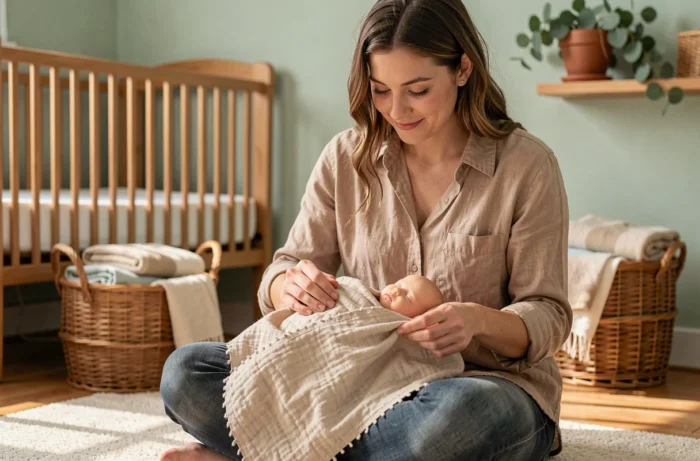
These checks take just a few minutes. They let you enjoy the real benefits of handmade products—carefully chosen materials, meticulous production in France, and personalization—without giving up the safety assurances that European regulations have specifically strengthened for online purchases.
Handmade baby creations: softness and rigor go hand in hand
A double-gauze muslin cloth sewn in a French workshop can be softer, more durable, and better finished than a mass-produced equivalent. Handmade quality is verified through the product listing, not the marketing pitch. By checking textile composition, manufacturer identification, and safety warnings, parents have a reliable way to assess a product.
The European regulatory framework in force since late 2024 gives every online shopper the same tools to assess a product, whether it comes from a large company or a local artisan. The difference between a good handmade accessory and a poor one comes down to the seller’s transparency, not the size of their workshop.