P6, or Neiguan in traditional Chinese medicine, is one of the most studied acupressure points for pregnancy-related nausea. Available clinical trials suggest it may have an antiemetic effect, but the quality of the evidence remains low to moderate, with substantial variation between studies and insufficient safety data.
The gap between the technique’s popularity and the strength of the evidence warrants a closer look at what we actually know, what is being stimulated, and when this technique reaches its limits.
P6 acupressure compared with other options for pregnancy nausea
Several approaches are used to manage nausea in the first trimester. Their levels of evidence and mechanisms of action differ considerably.
| Option | Mechanism of action | Level of evidence | Main limitations |
|---|---|---|---|
| P6 acupressure (wristband or manual pressure) | Stimulation of a point on the pericardium meridian, on the inner forearm | Low to moderate (variation between trials) | Effectiveness varies depending on wristband placement; safety data are insufficient |
| Acupuncture (needles) | Needle stimulation of the same point or related points | Moderate | Requires a trained practitioner; results are not interchangeable with those for acupressure |
| Ginger (supplements or infusion) | Prokinetic action on gastric motility | Moderate | Dosage is not well standardized; possible interactions |
| Antiemetic medications (doxylamine, ondansetron) | Block nausea receptors (antihistamine or 5-HT3 antagonist) | High | Requires a prescription; possible side effects (drowsiness, constipation) |
This table shows that P6 acupressure has a lower level of evidence than medication. It remains a complementary option, not a substitute. Results from needle acupuncture do not automatically apply to a pressure wristband or manual stimulation.
A detailed resource on P6 acupressure for pregnancy nausea provides more information about the anatomical features of this point.
Locating the P6 point: anatomical landmarks and positioning errors
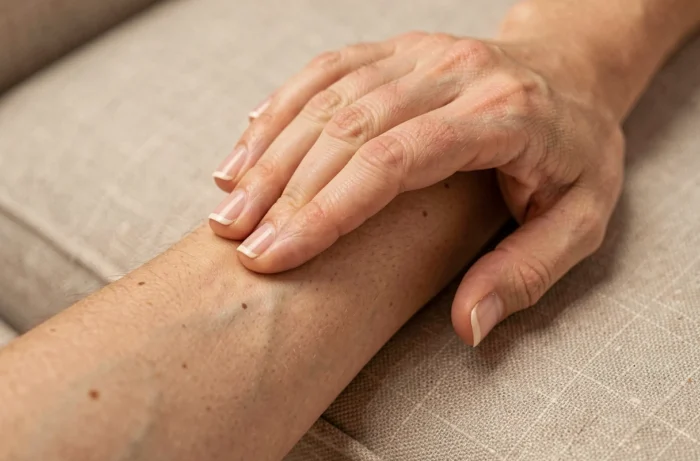
P6 is on the inner forearm, about three finger-widths from the wrist crease, in the hollow between the two palpable tendons (the palmaris longus and flexor carpi radialis). To find it, place the index, middle, and ring fingers of your opposite hand just above the wrist crease. The point is beneath the edge of your ring finger, in the groove between the tendons.
A poorly positioned wristband may not stimulate the intended point. One way to check is to press the area and look for slight tenderness: if you feel nothing, the wristband is probably misplaced. The wristband should apply comfortable pressure, without causing numbness or a change in finger color.
Manual technique without a wristband
Use the thumb of your opposite hand to apply manual stimulation. Press firmly but comfortably, making small circles for two to three minutes. Repeat several times a day if the nausea returns.
- Place your thumb between the two tendons, not on a tendon (the pressure would be ineffective and uncomfortable)
- Maintain steady pressure rather than applying brief, repeated presses, giving the stimulation time to work
- Alternate between both wrists, as the point is present on each forearm
Warning signs: when pregnancy nausea goes beyond self-care
P6 acupressure is a self-care measure. It does not correct dehydration or treat complications of hyperemesis gravidarum. Being unable to keep fluids down, passing very little or dark urine, dizziness, or weight loss are signs that warrant prompt contact with a midwife or doctor.
The line between ordinary first-trimester nausea and a medical condition is not always clear. Typical pregnancy nausea, although unpleasant, generally still allows you to stay hydrated between episodes. When vomiting continues for several hours and no fluids stay down, the situation is no longer manageable with acupressure or ginger alone.
Practical criteria for assessing the situation
- Frequency of vomiting: a few episodes a day are within the usual range during pregnancy, while repeated vomiting that prevents any intake requires medical advice
- Urine color and frequency: clear, regular urination indicates adequate hydration, while dark or infrequent urine signals a risk of dehydration
- Weight loss: any significant weight loss in the first trimester should be reported to a healthcare professional
- Extreme fatigue or dizziness when standing: these symptoms, combined with vomiting, suggest that care beyond self-care may be needed

P6 acupressure and acupuncture: distinct interventions
The terms are often confused, including in some publications. Acupressure uses external pressure (a finger, wristband, or elastic band). Acupuncture involves inserting fine needles by a qualified practitioner. Results from needle-based trials do not automatically apply to a pressure wristband.
This distinction directly affects how studies should be interpreted. A meta-analysis that groups acupuncture and acupressure into a single category artificially increases the number of participants while combining two forms of stimulation that may have different effects. When trials involving wristband acupressure alone are considered, the effectiveness signal remains, but the effect size decreases.
For a pregnant woman who wants to try this approach, the distinction is also practical: acupressure can be done at home on your own, whereas acupuncture requires an appointment with a trained practitioner. This affects how easy it is to fit into daily life, especially during the most difficult weeks of the first trimester.
The P6 point remains a documented complementary tool, but the evidence for its effectiveness is no substitute for medical care. The most useful takeaway is simple: a correctly positioned wristband and properly performed manual technique may ease discomfort, but any nausea that prevents you from staying hydrated requires medical attention.