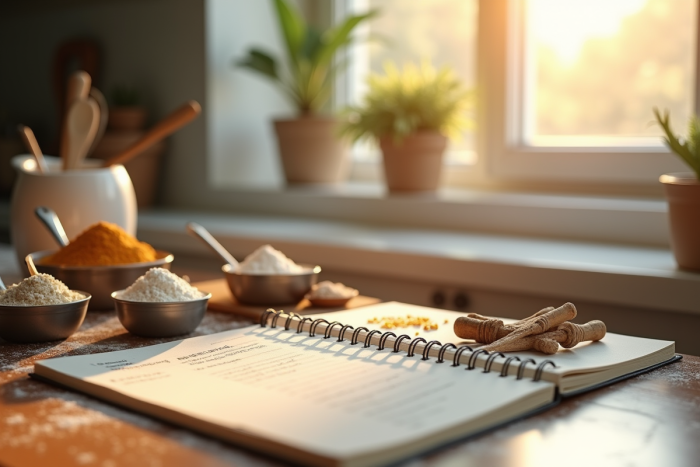
A standard tablespoon does not contain the same amount of liquid everywhere in the world: 15 ml in France, 20 ml in Australia. A measuring cup can display different graduations depending on the manufacturers. Converting grams to milliliters depends on the density of each ingredient, which complicates the application of international recipes.
Margins of error of a few milliliters or grams can be enough to alter the texture or taste of a dish. The absence of precise equivalents often leads to unexpected results, even when following the instructions to the letter.
Why measurement conversions are essential for successful recipes
Precision is not a luxury reserved for professionals: it is essential as soon as one wishes to faithfully reproduce a recipe. Switching from one unit of measurement to another is never trivial. Flour, sugar, milk, or oil, each of these ingredients has its own density and reacts differently depending on the amount used. A little too much water in a dough and it sticks to your fingers, impossible to shape. A shift of a few milliliters or centiliters, and the cream won’t set, the sauce separates.
Recipes rarely specify “approximately”: they expect precise measurements, sometimes down to the gram. But between American cups, English ounces, varying sizes of spoons, and glasses filled to different levels, it becomes a puzzle. To succeed, one often has to rely on equivalents. For example, converting 120 ml to cl requires knowing the exact conversion, without approximation. This vigilance makes all the difference; it draws the line between a coherent preparation and an uncertain result.
Using the correct conversions protects against many mishaps: uneven cooking, excess salt, texture that is too fluid or too compact. Weighing carefully, adjusting to the centiliter, measuring without relying on chance, this is how professionals ensure success. For them, every detail counts: the accuracy of a measurement, the rigor of a conversion, the attention to the unit used makes all the difference between an approximate dish and a well-executed preparation.

Practical charts, tips, and points of caution for error-free measurements in cooking
To avoid any approximation and gain certainty, there are simple tools and benchmarks to know. Here’s what allows for accurate measurements in every preparation:
- A conversion chart that is always accessible simplifies the transformation between centiliters and milliliters or vice versa. For example, remember that one centiliter always corresponds to 10 milliliters: this benchmark applies to all liquids, without exception.
- A digital kitchen scale ensures precise weighing, whether for flour, sugar, or even liquids. Its reliability helps avoid discrepancies due to “eyeballing” estimates.
- Graduated measuring cups and stainless steel spoons allow you to follow a recipe that alternates between grams and milliliters without making mistakes in quantity.
| Unit | Equivalent |
|---|---|
| 1 tablespoon | 15 ml |
| 1 teaspoon | 5 ml |
| 1 glass | 20 cl |
Some pitfalls often recur. Here are the traps to watch out for to avoid being caught by a measurement error:
- Mixing up the tablespoon and the teaspoon, which can disrupt the balance of a preparation.
- Filling a glass “approximately” without considering its actual capacity.
- Underestimating the density of an ingredient, such as flour or honey, which do not have the same mass for an equivalent volume.
Tech enthusiasts can rely on mobile applications or dedicated conversion calculators. These digital solutions facilitate complex conversions and limit the risk of error.
Adopting these tools, systematically checking your charts, adjusting each measurement methodically: this is the recipe for a kitchen where success is not left to chance. Through rigor, precision becomes a reflex, and it is this that, discreetly, elevates an ordinary recipe to the category of impeccable dishes.