
An email address at laposte.net can be created in just a few minutes, for free, and benefits from the reassuring image of a historic French operator. For strictly personal use, the question does not arise. For professional use, the situation changes: account governance, reliable archiving, GDPR compliance, and encryption of sensitive exchanges become selection criteria. This article compares the functions actually available on laposte.net with the requirements of a business email service in 2026.
Laposte.net Email vs. Professional Requirements: Comparative Table
Before making a decision, it is essential to lay out the criteria side by side. The table below contrasts the features of a free laposte.net mailbox with what a professional activity, even a modest one, expects.
| Criterion | Laposte.net (free) | Administered Professional Email |
|---|---|---|
| Access management (creation, deletion, permissions) | Individual, no centralized administration | Multi-user administration console |
| Custom domain name | No (address in @laposte.net) | Yes ([email protected]) |
| Reliable archiving | No | Possible depending on the provider |
| End-to-end encryption | Not guaranteed for attachments | Available (S/MIME, PGP, or integrated solution) |
| Message lifecycle (retention, purging) | Manual, the user’s responsibility | Automated policies |
| GDPR compliance (employee access rights, portability) | No dedicated tools | Logging, export, traceable deletion |
| Dedicated support | Public assistance | Professional support with SLA |
The conclusion is clear: laposte.net remains an individual mailbox without administrative functions. As soon as an organization employs even one person, the lack of centralized account management poses a concrete governance issue. A review on SOS Technologies details the technical limitations of this email service in a professional context.

Email Archiving and Legal Obligations in Business
The distinction between backup and archiving is often overlooked, yet it has direct legal consequences. Backup is used to restore lost data, while archiving must preserve the integrity and traceability of messages. A laposte.net mailbox does not offer either in a structured manner.
For activities subject to proof or retention obligations (accounting, contracts, client exchanges), a simple “sent messages” folder in a webmail does not constitute reliable archiving. The integrity of the message, the certain date, and access control must be guaranteed by dedicated technical mechanisms.
Employee Access Rights to Professional Emails
Recent case law has confirmed that professional emails can constitute personal data under GDPR. An employee can exercise their right of access to messages concerning them, even after leaving the company.
This obligation requires the employer to be able to retrieve, export, or delete messages in a traceable manner. On an informally shared laposte.net mailbox, responding to a GDPR access request becomes technically impossible without procedures or logging.
The reverse situation also poses a problem: when an employee leaves the company, the laposte.net mailbox belongs to them personally. The employer has no leverage to recover or delete the professional exchanges that passed through it.
Attachment Encryption: A Often Overlooked Flaw
Traditional email services transmit messages in clear text between servers, or at best with opportunistic transport encryption (TLS). This does not mean that the content is protected end-to-end.
For sensitive data (quotes, contracts, client information, health data), the absence of end-to-end encryption exposes the company to a risk of leakage. Laposte.net does not offer this functionality natively. Professional solutions integrate protocols like S/MIME or PGP, or provide secure portals for sending large files.
Moreover, GDPR imposes “appropriate” technical measures to protect personal data in transit. Using a public email service without encryption to exchange client or employee data weakens the company’s position in case of an audit or complaint.
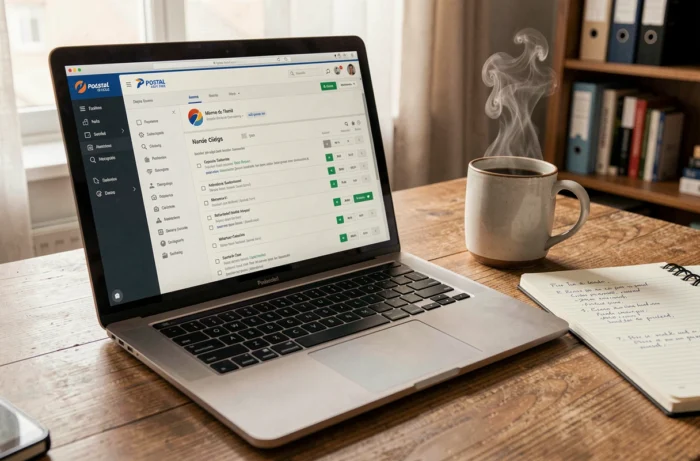
Professional Email Address and Brand Image: What the Recipient Perceives
A less technical but equally decisive aspect concerns the recipient’s perception. Receiving a quote from [email protected] does not have the same effect as [email protected].
The address with a custom domain serves three simultaneous functions:
- It immediately identifies the company in the recipient’s inbox, even before the message is opened
- It reduces the risk of being classified as spam, as anti-spam filters treat authenticated professional domains (SPF, DKIM, DMARC) differently from free addresses
- It allows control of the address if the employee changes positions or leaves the organization, since the domain belongs to the company
A free address ties professional identity to a personal account, creating a dependency on the employee or manager who created it.
Use Cases Where laposte.net Remains Relevant for Professionals
Systematically rejecting laposte.net would be excessive. For certain profiles, this email service meets the real need without additional investment.
- A self-employed person in the launch phase, without employees, handling a low volume of non-sensitive messages
- A secondary address used for registrations on platforms, newsletters, or third-party services, dissociated from client communication
- A temporary use while waiting for the implementation of a professional solution with a domain name
In these situations, the free service and ease of creation are real advantages. The problem arises when this temporary solution becomes permanent without the needs being reassessed.
The choice of a professional email service is not just a matter of convenience or budget. Account governance, compliant archiving, encryption of sensitive exchanges, and control of the domain name form a foundation that laposte.net, designed for the general public, does not claim to cover. Every organization benefits from aligning its email tool with its actual obligations rather than its habits.