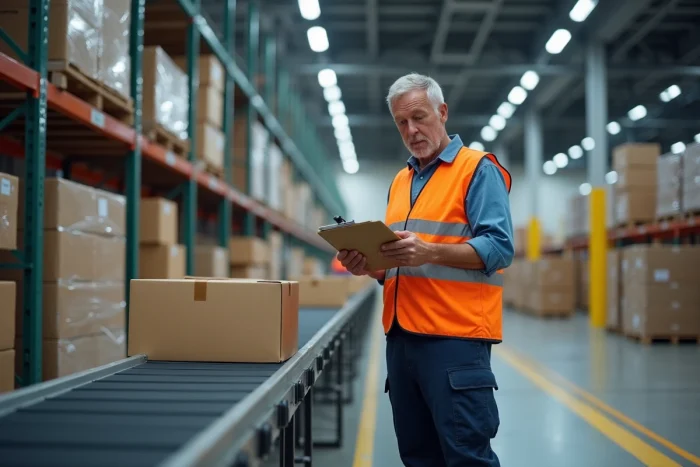
A package that suddenly stops at the Harnes hub, while others continue on their way at full speed: this scenario repeats itself, sometimes defying the apparent logic of a perfectly oiled machine. Behind this unexpected pause lies a much more complex reality, involving tight flows, impromptu checks, and real-time logistical decisions.
At the heart of sorting, each package becomes a number in a gigantic automated choreography. But sometimes, the rhythm falters. Some parcels, identified by detection systems or human decision, undergo additional inspections. Others see their priority order shift, a consequence of a last-minute adjustment dictated by flow management or the urgency of ongoing shipments.
The Harnes hub: understanding its central role in package delivery
Located at a strategic crossroads between Paris, Lille, and Brussels, the Harnes hub plays a major role in the French logistics system. Every night, this sorting center, spread across the Hauts-de-France region, orchestrates the passage of hundreds of thousands of packages from all corners of France and Europe. Its goal: to direct each shipment to the right destination using automated sorting technology and optical reading.
To better understand the workings of this organization, here are the main steps that govern the site’s operation:
- Mass arrival of trucks from various regional platforms,
- Unloading and sorting according to the indications on each package,
- Routing to local relays or long-distance lines depending on the journey to be made.
But even the smallest imbalance can jam the machine. During peak periods, such as Black Friday or holidays, the pace quickens, the optical reading must absorb a deluge of information, and the slightest anomaly can lead to cascading delays.
Harnes is not just a transit platform. This center also acts as a control point: some shipments are selected for thorough checks, particularly regarding compliance or packaging integrity. In these cases, the package being processed at the Harnes hub may be held for several hours, or even days, while all checks are completed. The page “Why does your package stay at the Harnes hub for several days? – We Undertake” details these situations and helps to better understand them.
What makes the Harnes hub a key link is also its position at the intersection of North-South logistics axes. Automation, the density of arrivals, and the concentration of flows create a permanent dynamic… and sometimes saturations, which are inevitable during major activity peaks.
Why can delays occur during processing at the Harnes hub?
The journey of a package through the Harnes hub is marked by stages where each mishap can have a domino effect. As soon as volumes explode, typically during Black Friday or around the holidays, the pace intensifies and the automated sorting lines sometimes reach their limits. Congestion looms, testing the robustness of the infrastructure.
The optical reading, intended to streamline the sorting, then encounters poorly labeled, damaged, or unreadable packages due to transport. These defective shipments escape the fast track and switch to manual verification, leading to additional delays. Added to this are security checks triggered by the nature of the package or the appearance of the packaging, which impose occasional but unavoidable stops.
Here are some examples of circumstances that frequently lead to notable slowdowns in the processing chain:
- Late arrivals of trucks, often due to road disruptions or unforeseen events in the logistics chain
- Technical failures affecting automated sorting systems
- Bottlenecks caused by the concentration of flows during very short time slots
In these situations, customer service finds itself on the front line, often called upon to explain or resolve a delivery delay whose origin goes beyond the hub’s operations. Despite the mobilization of logistics teams to limit these disruptions, the complexity of transit and the diversity of packages processed sometimes make the equation difficult to solve without additional delays.

Tracking, advice, and solutions in case of blocked or delayed packages
When the Harnes hub status remains displayed for too long on the tracking, the temptation to refresh the tracking number repeatedly is great. This identifier, which traces each step of the journey, can suddenly freeze, indicating a temporary stop at the hub. A persistent stagnation then deserves special attention.
Act quickly to unblock the situation
To best respond to this type of blockage, several actions can be taken:
- Regularly check the tracking space provided by the sender or carrier
- Contact customer service with the tracking number and shipping date at hand
- Ensure that no address or recipient information errors are hindering the processing of the package
A delivery delay observed at the Harnes hub may also be related to delays in handling by a relay or to routing errors within the sorting center itself. In these cases, contacting customer service often proves decisive: they hold internal information, can initiate a thorough search, and, if a blockage is confirmed, expedite the processing procedure.
Professionals, whether shippers or recipients, have specific mechanisms to quickly report an incident. A responsive exchange with the service in charge of the Harnes hub can then provide a solution and get the package back on track, whether for home delivery or a relay point.
At the end of the conveyor belt, patience sometimes remains the last step of the journey. But careful monitoring, combined with the vigilance of logistics teams, often transforms the wait into a mere parenthesis before the resumption of movement.