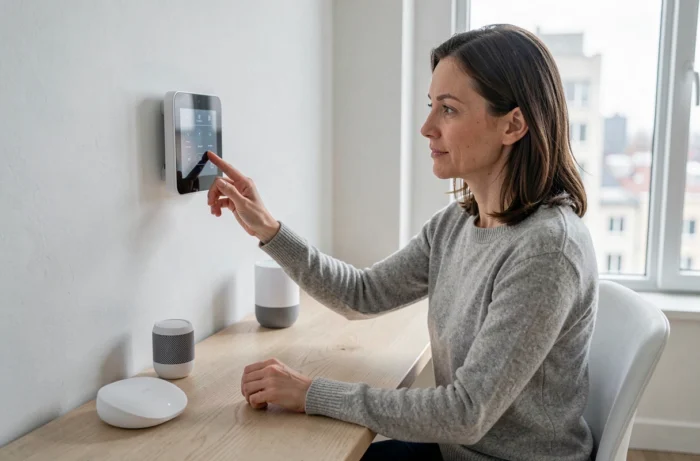
Your phone woke you up this morning, your watch counted your steps, and an app suggested a route to help you avoid traffic. Technological innovations are no longer confined to laboratories or trade shows. They’re woven into the most ordinary parts of our day, from waking up to going to bed, reshaping our habits—often without us even noticing.
Digital sustainability: the hidden cost of everyday devices
Have you ever noticed that your internet router stays on all the time? This seemingly insignificant detail has a real impact. The Digital Usage Reference Guide published by Arcep and Arcom in June 2024 states that internet routers and TV set-top boxes accounted for 0.7% of France’s electricity consumption in 2022. The same report notes that energy consumption by networks and data centers increased that year.
The actions commonly associated with digital sustainability—deleting emails or lowering video quality—aren’t necessarily the measures that have the greatest impact on our environmental footprint. Extending the lifespan of devices remains the most effective measure, according to the same guide. Keeping a smartphone for another year or putting off replacing a computer makes more difference than clearing out your inbox.
Many articles published in Culture Bretagne’s tech section explore these digital footprint issues from practical angles, helping readers get a clearer picture.
Remote work and personal life: what digital tools really change
Remote work has become part of the professional landscape, mainly in a hybrid format. According to Insee, it remains more common among managers and varies considerably from one industry to another. Many jobs simply aren’t suited to working remotely.
Greater autonomy comes at a cost. Insee reports that remote workers receive less support from their colleagues and managers. Screens replace informal conversations, and some workplace tensions are harder to resolve remotely.
Home life: a rebalancing that may be more illusion than reality
Remote work makes it easier to balance professional and personal life, particularly for men. But according to Insee, it doesn’t lead to a more equal division of household chores among couples. Working from home doesn’t automatically redistribute household responsibilities.
This finding challenges the common assumption that digital tools free up time for everyone in the same way. Technology provides a framework, but how people use it is still shaped by deeply rooted social habits.
Artificial intelligence and European regulation: a clearer framework
Artificial intelligence is making its way into healthcare, transport, social media, and public administration. From voice assistants to recommendation filters, it already influences some of our everyday decisions.
To regulate these uses, the European Union adopted the AI Act, a regulation that classifies AI systems according to their level of risk. Here are the main categories set out in the legislation:
- Unacceptable risk: systems that manipulate human behavior or exploit vulnerabilities are prohibited (such as generalized social scoring).
- High risk: systems used in recruitment, justice, or healthcare must meet strict transparency and human oversight requirements.
- Limited or minimal risk: chatbots and spam filters are subject to lighter requirements, such as informing users that they’re interacting with AI.
This regulatory framework is being phased in gradually. Bans on unacceptable-risk systems take effect first, followed by requirements for high-risk systems. The aim is to protect citizens without holding back technological development.

Connected health and prevention: practical uses, but unequal access
Smartwatches track heart rate, sleep, and physical activity. Some can detect irregular heart rhythms and alert users before any symptoms appear. In healthcare, these technological innovations are bringing preventive care into everyday life.
Access remains the real issue
These digital tools require a device, a reliable internet connection, and a basic level of comfort with digital interfaces. The digital divide isn’t just about access to the internet; it’s also about people’s ability to make use of the services available. An older person without a smartphone can’t benefit from telehealth, even if the service is available in their town.
Healthcare technology is advancing rapidly, but adoption depends on social, economic, and generational factors. The development of these tools alone doesn’t guarantee that everyone will benefit equally from better preventive care.
What’s changing our lifestyles for good
Three changes stand out as irreversible:
- Instant communication has reshaped our expectations around responsiveness, both at work and in our personal lives. Replying within minutes has become the norm.
- Access to information has become more widespread, but the ability to verify a source is now a skill in its own right.
- The boundaries between work and personal time have blurred, with digital tools making everyone reachable at all times.
These changes aren’t inherently good or bad. Their impact depends on how each of us incorporates them into our lives, and on the collective frameworks—regulatory, educational, and professional—that support them. The real challenge in the years ahead is less about the power of innovation than about our ability to choose which innovations deserve a place in our daily lives.